

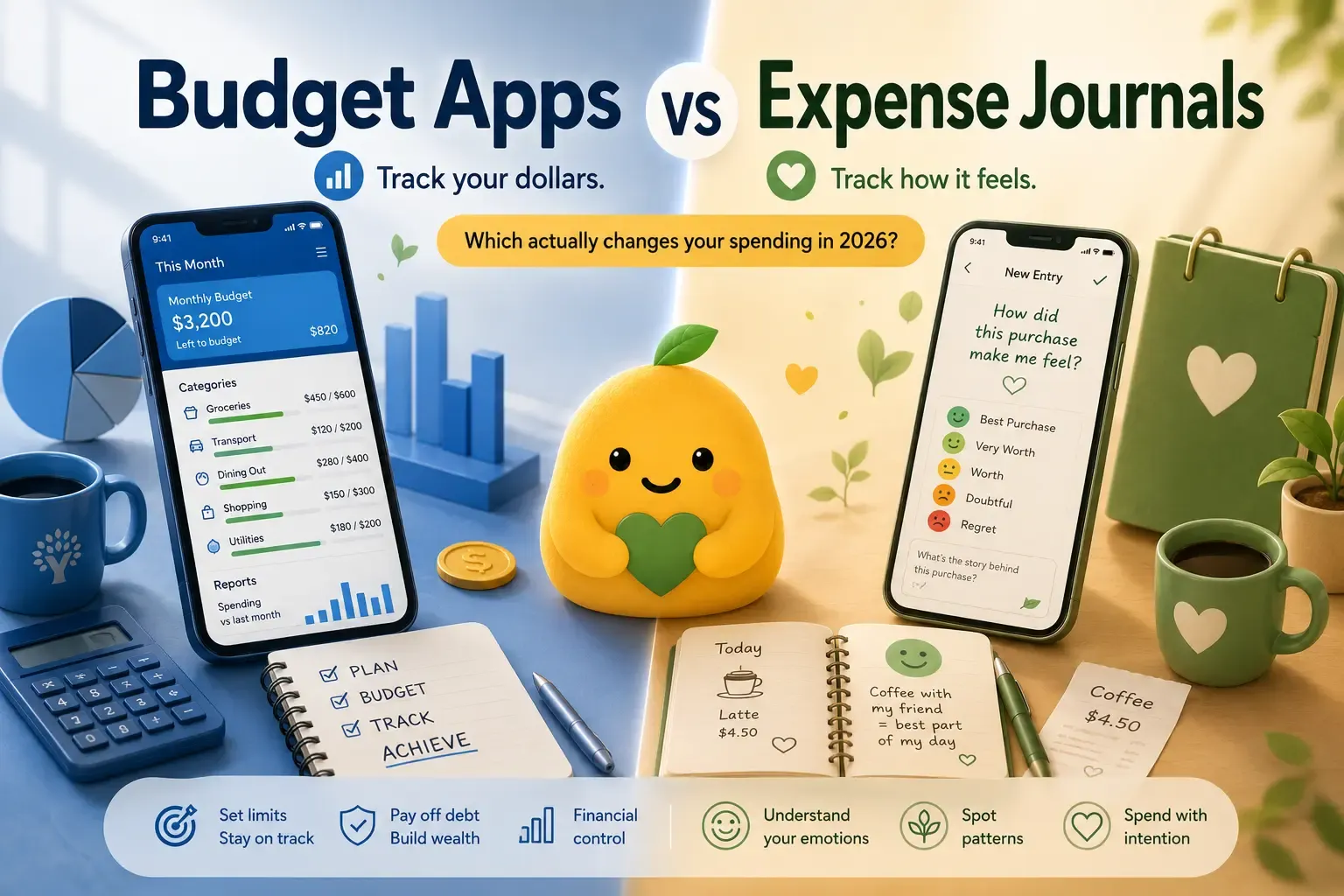
Budget Apps vs Expense Journals: A 2026 Comparison
Wed Jul 15 2026
TL;DR: Budget apps win for financial control: categories, limits, and debt planning. Expense journals win for emotional insight: understanding why you spend. Choose a budget app if you need to enforce a plan. Choose an expense journal if you want to understand your patterns. Use both for the best results: budget for planning, journal for reflection.
A 2026 Intuit survey found that 49% of consumers are committing to mindful spending. But “mindful spending” means different things to different people. For some, it is a strict budget with category limits and monthly reviews. For others, it is a simple journal where they log purchases and reflect on how they feel.
These two approaches look similar on the surface. Both involve tracking what you spend. But they operate on fundamentally different assumptions about why people overspend and what it takes to change that behavior.
Quick Comparison Table
| Category | Budget Apps | Expense Journals |
|---|---|---|
| Best For | Financial control and debt payoff | Spending awareness and emotional insight |
| Core Method | Categories, limits, and tracking progress | Mood ratings, reflection, and pattern recognition |
| Typical Price | $8-$15/month subscription | Free or one-time purchase |
| Setup Time | 30-60 minutes | 10 seconds |
| Bank Sync | Yes (automatic import) | No (manual entry) |
| Emotional Tracking | No | Yes |
| Debt Planning | Yes (built-in calculators) | No |
| Net Worth Tracking | Yes | No |
| Daily Effort | 2-5 minutes per session | 10 seconds per transaction |
| Success Rate (6 months) | ~20% (Journal of Consumer Behaviour, 2025) | Higher for people who struggle with budgets |
| Our Verdict | Best for financial control | Best for spending awareness |
Which Is Easier to Start?
Expense journals win on ease of starting because they require no setup, no categories, and no decisions before you begin. You download the app and start logging. The first entry takes 10 seconds. There is no budget to configure, no categories to create, no accounts to sync.
Budget apps require a significant upfront investment. You need to connect bank accounts, create budget categories, set spending limits, and decide how to categorize your recurring expenses. For a tool that 80% of users abandon within six months, that setup friction is a problem.
A 2025 study in the Journal of Consumer Behaviour found that restrictive budgeting approaches fail for 80% of users within six months. The primary reason is not that the tools are bad. It is that the cognitive load of maintaining categories and limits exceeds what most people can sustain.
Verdict: Expense journals win on ease of starting. Budget apps require commitment before they deliver value.
Which Helps You Understand Your Spending?
Expense journals win on understanding because they reveal something budget apps cannot: the emotions behind your purchases. A budget app can tell you that you spent $450 on dining out last month. It cannot tell you whether those meals brought you joy, regret, or indifference. That is the information that changes behavior.
When you log a purchase in an expense journal, you rate it on a simple scale: Best Purchase, Very Worth, Worth, Doubtful, Regret. After a few weeks, patterns emerge. You might discover that takeout always lands in the “Regret” category while coffee with a friend always lands in “Best Purchase.” That insight changes what you do next.
Budget apps track the symptom. Expense journals track the cause. The symptom is where your money went. The cause is why you spent it.
Verdict: Expense journals win on understanding. Budget apps answer “where.” Expense journals answer “why.”
Which Builds Long-Term Habits?
This is a tie because the two approaches build habits through different mechanisms, and the best choice depends on the person. Budget apps use external discipline: the structure forces you to make decisions in advance. Expense journals use intrinsic awareness: seeing your patterns changes how you think.
Budget apps work well for people who respond to structure. The categories and limits create a frame that guides decisions. Over time, the habit becomes internalized. Many YNAB users report that after a year, they no longer need the app because the methodology has become automatic.
Expense journals work well for people who have tried budgets and failed. The low friction and absence of guilt make them sustainable. The insight comes from reflection, not restriction. Users report that after a few weeks, they start pausing before purchases naturally, without needing to log every transaction.
The best outcome is using both. A budget for planning what you intend to spend. A journal for reflecting on what you actually spent and how it felt.
Verdict: Tie. Budget apps for external discipline. Expense journals for intrinsic awareness.
Which Is More Affordable?
Expense journals win on affordability because most are free, while budget apps charge $8-$15 per month. YNAB costs $109 per year. Monarch Money costs $99.99 per year. PocketGuard costs $74.99 per year. These are not unreasonable prices for what they deliver, but they create a barrier.
Expense journals are typically free or have a one-time purchase model. There are no subscription fees, no trials to cancel, no recurring charges. The cost of trying an expense journal is zero.
If you are unsure which approach will work for you, starting with a free expense journal removes all financial risk. You can always add a budget app later if you need more structure.
Verdict: Expense journals win on price. Free vs $75-$109/year is a significant difference.
Which Is Better for Financial Control?
Budget apps win on financial control because they are purpose-built for it. If you need to pay off debt, track net worth, or enforce spending limits in specific categories, a budget app is the right tool. The features are designed for this job: loan simulators, category limits, subscription trackers, and rollover budgets.
Expense journals do not compete on this dimension. They do not track categories, set limits, or calculate debt payoff timelines. If financial control is your primary goal, an expense journal alone will not meet your needs.
However, expense journals can inform your budgeting. The emotional data you collect helps you make better budgeting decisions. If you know that dining out consistently leads to regret, you can set a stricter limit on that category in your budget app.
Verdict: Budget apps win on financial control. Expense journals inform but do not replace budgeting.
Who Should Choose What
People who need to pay off debt or enforce strict limits. Choose a budget app. YNAB, Monarch Money, or EveryDollar will give you the structure you need. The subscription cost is justified by the debt payoff results.
People who want to understand their spending patterns. Choose an expense journal. Worth is a free mood-based journal that shows you which purchases bring you joy and which ones you regret.
People who have tried budgeting and failed. Start with an expense journal. The low friction and reflection-based approach will build awareness without triggering the guilt cycle that caused you to abandon budgets before.
People who want both control and awareness. Use a budget app for planning and an expense journal for reflection. They complement each other. One handles the numbers. The other handles the emotions.
Frequently Asked Questions
Is a budget app better than an expense journal?
They serve different purposes. A budget app is better for controlling where your money goes. An expense journal is better for understanding why you spend. The best choice depends on your goal. If you need to reduce spending in a specific category, a budget app will help. If you want to understand your emotional triggers, an expense journal will help.
Can I use a budget app and an expense journal together?
Yes. This is the recommended approach. Use a budget app to plan your spending and track categories. Use an expense journal to log how you feel about each purchase. The two tools provide different data sets that together give you a complete picture of your financial life.
How long does it take to see results from an expense journal?
Most users report seeing clear patterns within two to three weeks of consistent logging. The key is to log every purchase and rate it honestly. After 30 days, you will have enough data to identify which spending categories consistently bring you joy and which ones lead to regret.
Do I need a budget if I use an expense journal?
Not necessarily. Many people find that the awareness built through journaling naturally changes their spending behavior. They no longer need the external structure of a budget because they have developed internal awareness. However, if you have significant debt or specific financial goals, a budget app provides the structure to reach them faster.
Is an expense journal worth it if I already have a budget?
Yes. A budget tells you what you spent. An expense journal tells you how you felt about it. These are different questions that require different tools. Most people discover that their actual spending patterns do not match their emotional responses. The disconnect between what you spend and how you feel about it is where the most valuable insights live.
Choose Your Approach
Budget apps and expense journals are not competitors. They are complementary tools for different parts of the same problem. Budgets give you control. Journals give you understanding. The best financial wellness strategy uses both.
Worth is a free expense journal that tracks how each purchase makes you feel. Download Worth on Google Play and start discovering what your spending says about you.
Sources
- Intuit Financial Wellness Survey 2026. Retrieved 2026-07-15. https://www.intuit.com/blog/innovative-thinking/2026-financial-forecast-mindful-stress/
- Journal of Consumer Behaviour (2025). Restrictive Budgeting Failure Rates.
- NerdWallet: Best Budget Apps 2026. Retrieved 2026-07-15. https://www.nerdwallet.com/article/finance/best-budget-apps
- CashNetUSA: Retail Therapy Statistics 2026. Retrieved 2026-07-15. https://www.cashnetusa.com/blog/retail-therapy/