

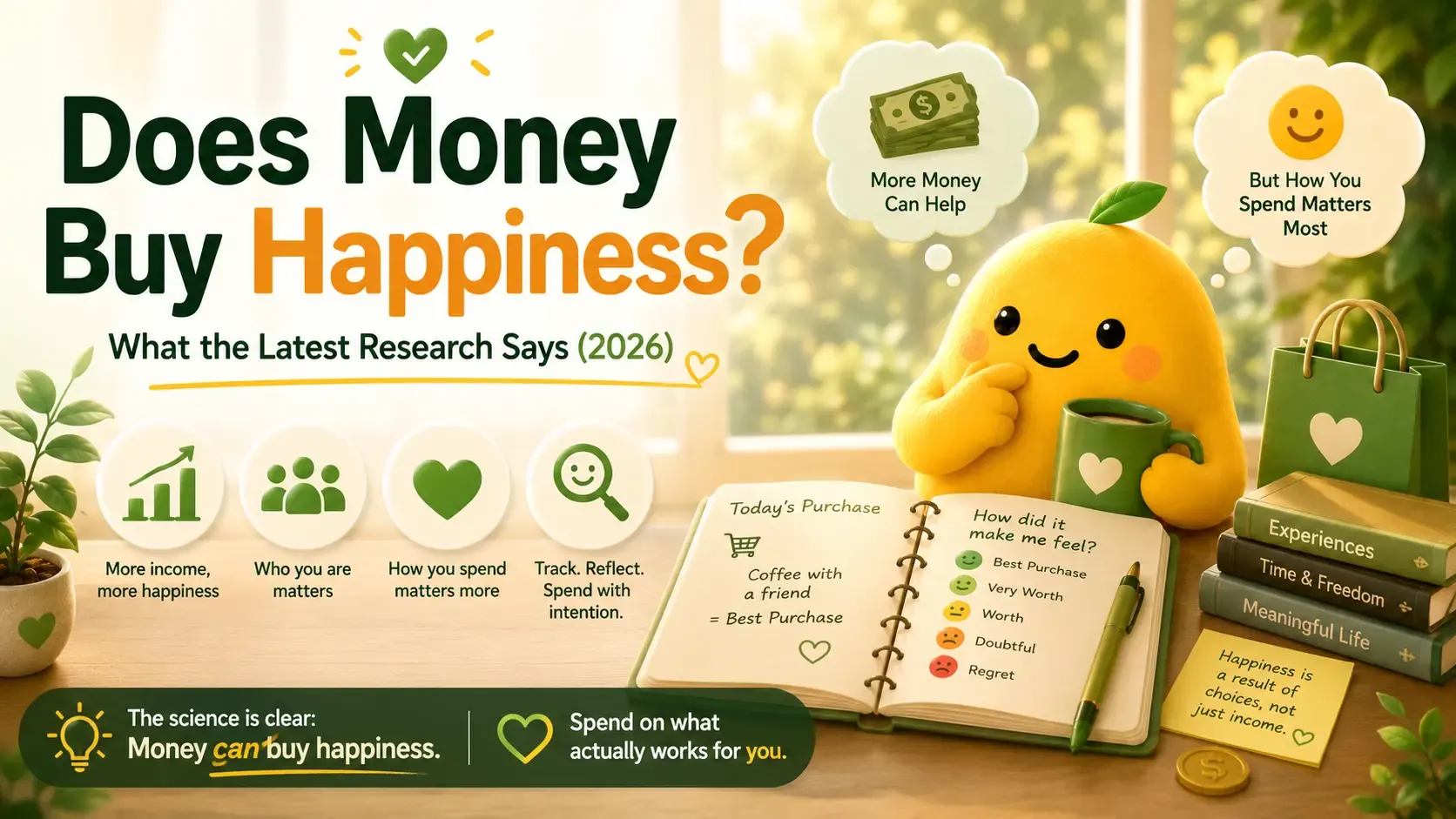
Does Money Buy Happiness? What the Latest Research Says (2026)
Wed Jul 15 2026
Key Takeaways
- The old idea that happiness plateaus at $75k is only true for one specific group of people.
- A landmark 2023 study by two researchers who once disagreed settled the debate: for most people, more money keeps bringing more happiness.
- But here is the catch: how you spend matters way more than how much you have.
- Most people never stop to ask whether their purchases actually make them happy. That simple question changes everything.
You have probably heard it a hundred times: “Money can’t buy happiness.” Or the more specific version: “Research shows happiness plateaus at $75,000 a year.”
Both of these are half-truths. And the real story is way more interesting.
Over the last few years, some of the world’s top happiness researchers went head to head on this question. They published studies that seemed to contradict each other. Then they did something rare in science. They teamed up to settle the debate once and for all.
What they found changes how you should think about every purchase you make.
Where the $75,000 Rule Came From
Back in 2010, two Nobel Prize-winning economists named Daniel Kahneman and Angus Deaton published a study that made headlines. They found that people’s happiness went up as their income rose, but only up to about $75,000 a year. After that, happiness leveled off. More money did not seem to make people any happier.
This finding was repeated everywhere. It became a cultural fact. You still see it quoted in articles, books, and conversations all the time.
But here is what most people missed. The 2010 study was not measuring happiness for everyone. It was actually measuring unhappiness. When you look at people who were already pretty happy, the data told a completely different story.
The Scientific Showdown That Changed Everything
In 2021, a researcher named Matthew Killingsworth at the University of Pennsylvania published a different study. He used an app that pinged people at random moments throughout the day and asked how they were feeling. His data showed something different from the 2010 study. Happiness kept rising with income, way beyond $75,000. There was no plateau.
Two respected studies. Two opposite conclusions. Something had to give.
Instead of arguing about it, Kahneman and Killingsworth did something unusual. They joined forces in what is called an adversarial collaboration. They brought in a third researcher, Barbara Mellers, to help them figure out who was right.
The result was published in 2023. And it turns out both studies were correct.
The Truth Depends on Who You Are
The combined research showed that people fall into three groups when it comes to money and happiness.
The first group is people who are already unhappy. For them, more money does boost happiness, but only up to about $100,000 a year. After that, it plateaus. If you are struggling emotionally, more cash helps you get to a stable place, but once you are there, extra money does not make much difference.
The second group is the majority of people. For them, happiness keeps rising with income in a steady, straight line. More money means more happiness, no matter how much they earn. The $75,000 plateau simply does not apply to them.
The third group is people who are already pretty happy. For them, happiness actually goes up faster as their income grows. More money seems to unlock things that make them even happier.
A 2024 follow-up study by Killingsworth went even further. He compared regular high earners making over $500,000 a year to actual millionaires. The millionaires were significantly happier. The gap in happiness between millionaires and middle income people was nearly three times larger than the gap between middle income and low income people. Money kept buying happiness all the way up the ladder.
The Part Everyone Misses
Here is where it gets practical for you.
All of these studies agree on one thing that does not get enough attention. Money can buy happiness, but only if you spend it in ways that actually work for you. Buying things that do not match your values, your personality, or your real needs will not make you happier, no matter how much you have.
Research consistently shows that spending on experiences, time-saving services, and things that support your hobbies or skills produces more happiness than spending on material goods. A 2026 study from Clemson University found that “activity engagement purchases” things that help you do something meaningful produce way more lasting happiness than buying stuff.
But here is the problem. Most people never stop to check whether their spending is actually working. They buy things, feel a quick rush, and move on. They never ask the only question that matters: Did that purchase actually make me happier?
A Simple Way to Find Out
You do not need a research study to know what works for you. You need one simple habit.
Start paying attention to how you feel about your purchases after you make them. Not right away, when the excitement is still fresh. Wait a few hours or a day. Then ask yourself: Was this worth it? Did it actually improve my day?
Rate each purchase on a simple scale. Best Purchase. Very Worth. Worth. Doubtful. Regret.
After a few weeks, patterns will appear. You might find that takeout always lands in the “Regret” category while buying ingredients to cook with friends always lands in “Best Purchase.” That is the information that actually changes how you spend.
This is not complicated. It takes about 10 seconds per purchase. But most people never do it. They keep spending the same way, wondering why their bank account is empty and they do not feel any happier.
Frequently Asked Questions
So does the $75,000 rule still apply?
Only if you are already pretty unhappy. For that group, happiness does plateau around $100,000. But for the majority of people, happiness keeps rising with income. The old rule was oversimplified.
Can I be happy without a lot of money?
Absolutely. Money is just one factor in happiness. Relationships, health, purpose, and meaningful activities matter a lot more. The research shows that for people who already have these things, more money adds to their happiness. But money alone will not fix a life that is missing the important stuff.
Does buying experiences really make you happier than buying things?
For most people, yes. Experiences create memories and connections. Things lose their novelty. But the 2026 Clemson research added a twist. What matters most is whether a purchase supports something meaningful in your life, not whether it is an experience or a thing.
How can I tell if my spending is making me happy?
Track every purchase and rate how you feel about it after. Do this for two weeks. You will see clear patterns. The answer is different for everyone. The only way to know yours is to look at your own data.
Is it bad to spend money on things that make me happy?
Not at all. The goal is not to stop spending. It is to spend on things that actually deliver happiness and stop spending on things that do not. That is the whole point.
Spend on What Actually Works
The science is clear. Money can buy happiness. But not automatically. Not for every purchase. Only when you pay attention to what actually works for you.
Most people never ask the question. You just did. That is the first step.
Worth is a free app that helps you track not just what you spend, but how each purchase makes you feel. Download Worth on Google Play and discover which purchases actually add happiness to your life.
Sources
- Killingsworth, M.A. (2024). Money and Happiness: Extended Evidence Against Satiation. Happiness Science. Retrieved 2026-07-15. https://happiness-science.org/money-happiness-satiation
- Killingsworth, M.A., Kahneman, D., & Mellers, B. (2023). Income and emotional well-being: A conflict resolved. Proceedings of the National Academy of Sciences. https://www.pnas.org/doi/10.1073/pnas.2208661120
- Penn Today (2023). Does more money correlate with greater happiness? University of Pennsylvania. Retrieved 2026-07-15. https://penntoday.upenn.edu/news/does-more-money-correlate-greater-happiness-Penn-Princeton-research
- Thyroff, A. & Hawkins, M. (2026). Activity Engagement Purchases and Consumer Happiness. European Journal of Marketing. Clemson University. Retrieved 2026-07-15. https://news.clemson.edu/new-study-challenges-conventional-wisdom-about-retail-therapy/