
Is Retail Therapy Real? The Science of Shopping and Mood (2026)
Tue Jul 14 2026
Key Takeaways
- The average American makes 107 retail therapy purchases per year and regrets 32% of them (CashNetUSA, 2026).
- Retail therapy is real. Shopping triggers dopamine release and can improve mood when used intentionally.
- A 2026 Clemson University study found that “activity engagement” purchases produce more lasting happiness than material goods.
- The difference between healthy and harmful retail therapy comes down to awareness and intention.
- Tracking your mood alongside your purchases helps you identify which spending actually improves your well-being.
Retail therapy has a reputation problem. The term is often used as a punchline, a guilty confession whispered after a long day and an overflowing shopping cart. But what if the science tells a different story? What if shopping can actually improve your mood, and the real problem is not retail therapy itself but doing it without awareness?
A 2026 CashNetUSA survey of 2,000 consumers found that the average American makes 107 retail therapy purchases per year. Millennials lead the pack at 160 annual purchases, while Baby Boomers average just 39. Across all age groups, 32% of those purchases end in regret. That means 68% do not. The majority of retail therapy purchases are not regretted. They serve a real psychological function.
The Case For: When Shopping Helps Your Mood
The brain science behind retail therapy is well established. When you anticipate a purchase, your brain releases dopamine, the same neurotransmitter associated with pleasure and reward. A 2025 Psychology Today article on retail therapy noted that planned, intentional purchases can improve mood and provide a sense of control, especially during times of stress.
Research from the Journal of Consumer Psychology has shown that making small, deliberate purchasing decisions restores a sense of personal control. When people feel powerless in other areas of their lives, choosing what to buy can counteract that feeling. The act of selecting, deciding, and acquiring provides a measurable psychological benefit.
Food is the most common form of retail therapy. The CashNetUSA survey found that 67% of Americans buy snacks and treats to boost their mood, and 49% buy takeout for the same reason. These small purchases serve as quick, accessible mood regulators. The problem is not the purchase itself. The problem is whether the purchase was made with awareness or impulse.
The Case Against: When Shopping Hurts
The same CashNetUSA survey reveals the downside. Americans regret nearly a third of their retail therapy purchases. For Millennials, who make the most retail therapy purchases, the financial impact adds up. A 2026 LendingTree survey found that 63% of consumers say their emotions influence what they purchase, and 43% have incurred debt from emotional spending.
The line between retail therapy and compulsive buying is crossed when shopping becomes the primary coping mechanism. When purchases are hidden from partners, when credit cards are maxed out, when the post-purchase guilt outweighs the pre-purchase excitement, retail therapy has stopped working.
The conventional advice is to stop retail therapy entirely. Cut up the cards. Delete the apps. Go cold turkey. But this advice ignores two realities. First, retail therapy works for most people most of the time. Second, deprivation leads to rebound spending. A 2025 study in the Journal of Consumer Behaviour found that restrictive budgeting approaches fail for 80% of users within six months.
What the 2026 Clemson Study Reveals About Shopping and Happiness
In March 2026, Clemson University researchers published a study in the European Journal of Marketing that challenges how we think about retail therapy. Associate professor Anastasia Thyroff and her colleague Matthew Hawkins found that not all purchases produce the same happiness. The key variable is not how much you spend or whether you buy a thing versus an experience. It is the purpose behind the purchase.
The researchers identified a category they call “activity engagement purchases.” These are purchases that help you do something meaningful, express your values, or develop a skill. Buying a guitar because you want to learn music is an activity engagement purchase. Buying a guitar because you had a bad day and wanted to feel better is not.
This distinction matters because it gives us a framework for evaluating retail therapy. The problem is not shopping to improve your mood. The problem is shopping to escape your mood. The former is intentional. The latter is reactive.
The Better Approach: Intentional Retail Therapy
The alternative to quitting retail therapy is not quitting. It is becoming intentional about it. The goal is not to stop shopping when you feel emotional. The goal is to know the difference between a purchase that will genuinely improve your day and a purchase you will regret by tomorrow.
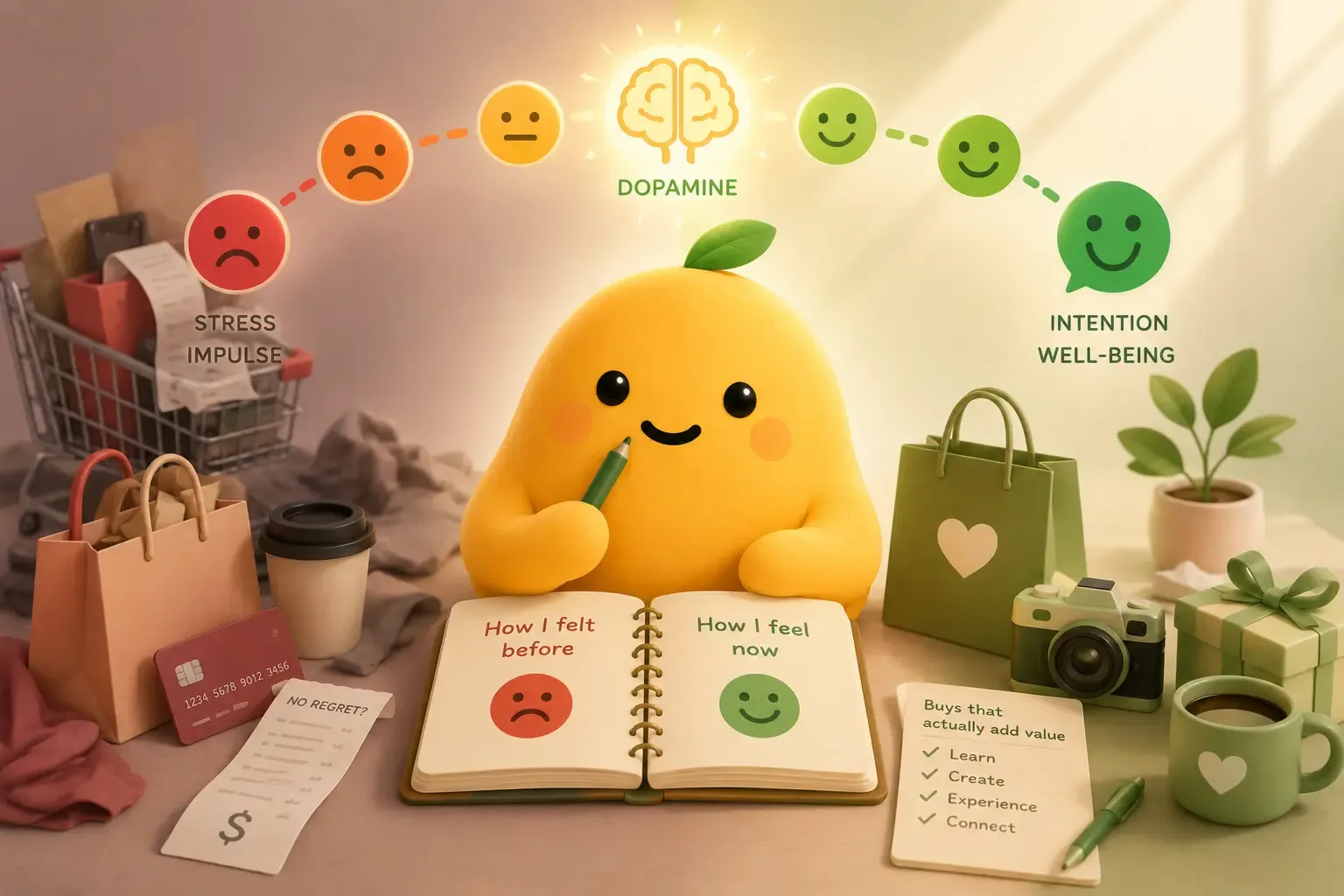
This requires a simple feedback loop. Before you buy, pause and ask: What am I feeling right now? What do I want this purchase to change? After you buy, reflect: Did this actually make me feel better? Would I make this choice again?
Most people never complete this loop. They buy, they feel the temporary high, and they move on. Without the reflection step, patterns never become visible. A person might spend hundreds of dollars on takeout during stressful weeks and never notice the connection because they never stopped to ask whether the takeout actually helped.
The five most reliable indicators of healthy retail therapy are awareness of the emotion driving the purchase, intention behind the choice, affordability without financial strain, absence of regret after the purchase, and alignment with your personal values. When a purchase meets these five conditions, it is not a problem. It is a tool.
How to Apply This Starting Today
Start by tracking every purchase and how you feel about it afterward. This takes 10 seconds per transaction. Use a simple five-point scale: Best Purchase, Very Worth, Worth, Doubtful, Regret.
After one week, look for patterns. What percentage of your purchases fall into each category? Do certain emotions lead to more regret purchases? Do certain times of day or situations trigger less intentional spending?
The data will show you where retail therapy works for you and where it does not. Some people find that buying food improves their mood without regret. Others find that clothing purchases consistently lead to guilt. The pattern is personal. The solution is awareness.
For purchases over $50, extend your reflection window. Do not evaluate the purchase immediately. Wait 24 hours and then ask the same question: Was this worth it? Immediate evaluations are distorted by the dopamine hit. Delayed evaluations are more accurate predictors of lasting satisfaction.
The 2026 Clemson study suggests prioritizing activity engagement purchases. When you feel the urge to spend on retail therapy, choose purchases that support a skill, a hobby, or a meaningful experience. These produce more lasting happiness than material goods and are less likely to result in regret.
Caveats
Retail therapy is not a substitute for professional mental health support. If shopping is causing significant financial distress, relationship problems, or is used as the sole coping mechanism for serious emotional difficulties, professional help is warranted.
The research on retail therapy is based on population averages. Your personal patterns may differ. The five-point scale described above will give you your own data, which is more useful than any general finding. The goal is not to follow a rule. It is to discover your own pattern.
Frequently Asked Questions
Is retail therapy a real psychological phenomenon?
Yes. Multiple peer-reviewed studies confirm that shopping can improve mood through dopamine release, restored sense of control, and social connection. The question is not whether it works. It is whether you are using it with awareness or as an escape from underlying issues.
How much retail therapy is too much?
A useful benchmark is the regret rate. The national average is 32%. If your personal regret rate exceeds this, or if you are hiding purchases from your partner, spending beyond your means, or using shopping as your primary coping mechanism, it is time to reassess.
Can retail therapy ever be good for you?
Yes, when practiced intentionally. A 2025 Psychology Today article confirmed that planned, budgeted purchases can improve mood and provide a sense of control. The key conditions are awareness, intention, affordability, and post-purchase reflection.
What is the difference between retail therapy and compulsive buying disorder?
Retail therapy is occasional shopping used to manage temporary emotional states. Compulsive buying disorder is a recognized mental health condition characterized by repetitive, uncontrollable purchasing that causes significant distress and impairment. The distinction lies in frequency, control, and consequences.
Are experiences really better than material purchases for happiness?
The evidence is more complex than the popular claim suggests. The 2026 Clemson study found that “activity engagement purchases” outperform both pure experiences and pure material goods. What matters is whether the purchase supports meaningful engagement, not whether it is an experience or a thing.
Shop With Awareness, Not Regret
Retail therapy is not the enemy. Mindless spending is. The science is clear that shopping can improve your mood when done with intention. The solution to bad retail therapy is not to stop shopping. It is to start paying attention.
Worth helps you track not just what you spend, but how each purchase makes you feel. Download Worth on Google Play and discover which purchases actually add value to your life.
Sources
- CashNetUSA: Retail Therapy Statistics 2026. Retrieved 2026-07-14. https://www.cashnetusa.com/blog/retail-therapy/
- Thyroff, A. & Hawkins, M. (2026). Activity Engagement Purchases and Consumer Happiness. European Journal of Marketing. Clemson University. https://news.clemson.edu/new-study-challenges-conventional-wisdom-about-retail-therapy/
- Psychology Today: Retail Therapy and the Expense of Coping (2025). Retrieved 2026-07-14. https://www.psychologytoday.com/us/blog/health-examined/202512/retail-therapy-and-the-expense-of-coping
- LendingTree: Emotional Shopping Survey 2026. Retrieved 2026-07-14. https://www.lendingtree.com/credit-cards/study/emotional-shopping/
- Psychology Today: Want to Spend Smarter? Start by Naming Your Feelings (2025). Retrieved 2026-07-14. https://www.psychologytoday.com/us/blog/the-psychology-of-debt/202504/want-to-spend-smarter-start-by-naming-your-feelings
- Intuit Financial Wellness Survey 2026. Retrieved 2026-07-14. https://www.intuit.com/blog/innovative-thinking/2026-financial-forecast-mindful-stress/