

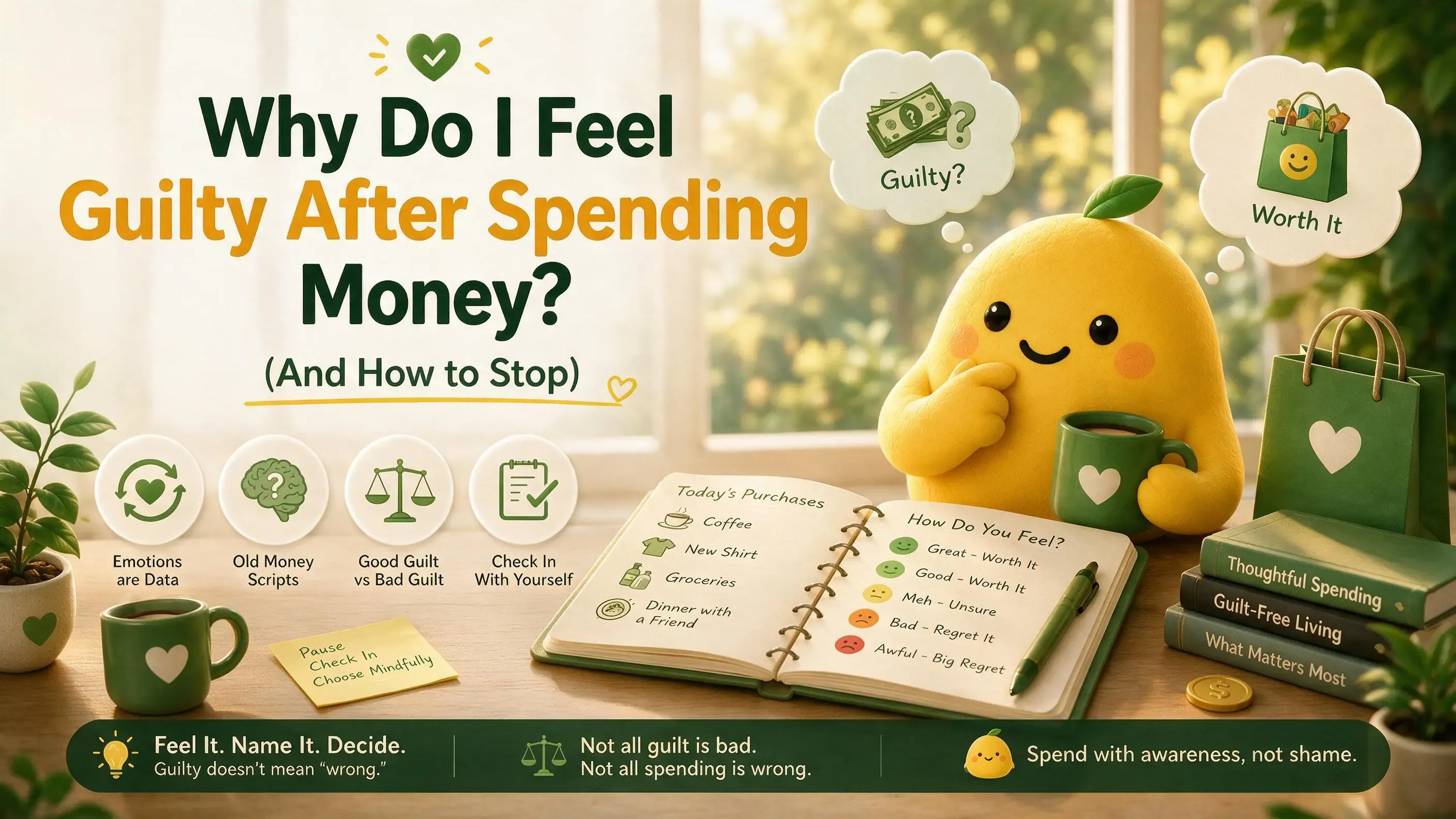
Why Do I Feel Guilty After Spending Money? (And How to Stop)
Wed Jul 15 2026
Key Takeaways
- Spending guilt affects almost everyone, but it is not always a useful signal.
- Most guilt comes from old money messages, not from actual bad decisions.
- The key is learning to tell the difference between guilt that helps you and guilt that just makes you feel bad.
- A simple habit of checking in with your feelings after a purchase can change everything.
You just bought something you have been thinking about for weeks. You can afford it. You actually need it. But the moment you hit “place order,” a familiar feeling creeps in. Your stomach tightens. You start second-guessing yourself. Maybe you should return it. Maybe you should have saved the money.
Sound familiar? You are not alone. Spending guilt is one of the most common feelings people have about money. And here is the surprising part. Sometimes it is a useful warning sign. But most of the time, it is just noise from old stories your brain is repeating.
Where Spending Guilt Really Comes From
Spending guilt does not come from the purchase itself. It comes from the meaning you attach to spending money.
For most people, that meaning was shaped long before they ever earned a paycheck. The way your parents talked about money. The phrases you heard growing up. “Money does not grow on trees.” “A penny saved is a penny earned.” “We cannot afford that.”
These messages sink in deep. They become the voice in your head that speaks up every time you spend. Even when you are spending responsibly on things you actually need or enjoy.
Research from the University of Michigan found that people’s financial behaviors in adulthood are strongly linked to the “money scripts” they learned as children. These scripts operate below the surface. You might not even know you have them. But they are running the show every time you feel that twinge of guilt at the checkout.
A 2023 study by Capital One and The Decision Lab found that 77% of Americans feel anxiety or guilt about their spending at least sometimes. That is more than three out of every four people. The guilt is not about the amount of money. It is about the act of spending itself.
The “Deserving” Trap
Here is a strange pattern. You can work hard all week, meet your goals, take care of your responsibilities, and still feel guilty about spending $15 on a nice lunch. Meanwhile, you might not think twice about spending $5 every day on coffee without asking yourself if you actually want it.
The guilt is not about the price tag. It is about whether the purchase feels “justified” or “indulgent.” And that line moves depending on your mood, your upbringing, and who is watching.
This creates what psychologists call the “deserving dilemma.” You feel like you have to earn the right to spend money, even on things that improve your life. So you delay, you bargain with yourself, and when you finally do spend, the guilt follows because somewhere deep down, you believe you do not deserve it.
But here is the thing. You do not need to earn the right to spend your own money on things that make your life better. The question is not whether you deserve it. The question is whether it actually works for you.
Good Guilt vs. Bad Guilt
Not all spending guilt is the same. Some of it is useful. Some of it is just noise.
Good guilt is the feeling you get when you spent money on something that does not align with your values or your goals. It is a signal that something is off. You bought something impulsively that you do not really need. You went over your budget. You spent money you did not have. This guilt is worth paying attention to. It is trying to tell you something.
Bad guilt is the feeling you get even when you made a perfectly reasonable purchase. You bought groceries. You paid for a service you use every day. You treated yourself to something you genuinely enjoy and can afford. The guilt is still there, but it is not based on reality. It is based on old scripts that have nothing to do with this purchase.
The problem is that most people never learn to tell the difference. They feel guilty about everything and eventually stop listening to guilt altogether. Or they let guilt run their lives and feel bad about every single purchase, even the ones that make them genuinely happier.
A Simple 3-Question Test
Here is a way to sort good guilt from bad guilt. Ask yourself three questions after every purchase.
First, does this purchase match my values? If you spent money on something that supports what matters to you, the guilt is probably noise. If you spent on something that goes against your values, the guilt might be telling you something.
Second, did I think about this purchase before I made it? A thoughtful purchase that you considered and decided on is very different from an impulse buy in the middle of the night. Thoughtful purchases deserve less guilt.
Third, how do I feel about this purchase a day later? Not right away. Wait until the next day. If the guilt fades, it was just noise. If it stays, there might be something to learn.
These three questions take about 30 seconds. But they change the entire conversation you have with yourself about money.
The Pain of Paying
There is a well-known concept in behavioral economics called the “pain of paying.” It was first described by researcher Drazen Prelec in 1998. The idea is simple. Spending money actually causes a mild form of pain in your brain. The same areas that light up when you experience physical discomfort also activate when you part with your money.
This is not a sign that something is wrong with you. It is a basic human response. Your brain is wired to hold onto resources. Spending triggers a protective response.
But here is what researchers also found. The pain of paying goes down when you feel connected to what you are buying. When a purchase feels meaningful or aligned with who you are, the pain decreases. When it feels random or disconnected from your life, the pain stays high.
This is why tracking how you feel about your purchases is so powerful. It gives you data that your brain cannot argue with. You can look back at your own history and see which purchases caused lasting guilt and which ones were worth every penny.
Why Most Financial Advice Gets This Wrong
Most personal finance advice treats spending guilt as a good thing. It tells you that guilt is your conscience protecting you from wasting money. Guilt is framed as the voice of responsibility.
But this is incomplete. Guilt without context is just noise. The goal is not to feel guilty about every purchase. The goal is to spend intentionally and then let go of guilt when you know the purchase was right for you.
A 2022 study in the Journal of Consumer Psychology found that people who practice mindful spending actually feel less guilt about their purchases, not more. They also report higher satisfaction with their spending overall. The key is not to spend less. The key is to spend with awareness.
Frequently Asked Questions
Is it normal to feel guilty after spending money?
Yes, it is extremely common. Research shows that over three-quarters of Americans feel spending guilt or anxiety at least sometimes. It is a normal human response, not a sign that something is wrong with you.
How do I stop feeling guilty about small purchases?
Start by noticing whether the guilt is about the amount or the act of spending. Small purchases often trigger guilt not because of the cost, but because of old money scripts. Try the 3-question test and see if the guilt holds up to scrutiny.
What is the difference between spending guilt and buyer’s remorse?
Spending guilt is the feeling you get during or right after a purchase, often before you have even used the thing you bought. Buyer’s remorse happens later, when you realize the purchase did not deliver what you expected. Guilt is about the act of spending. Remorse is about the outcome.
Can spending guilt ever be useful?
Yes. When it signals that you spent against your values or your plan, guilt is a useful warning. The key is learning to tell the difference between guilt that is a signal and guilt that is just old baggage.
Why do I feel guilty even when I can afford it?
Because spending guilt is not about the money. It is about the meaning you attach to spending. If you grew up with messages that spending is irresponsible or indulgent, that voice stays with you regardless of your bank account.
Spend with Awareness, Not Guilt
The goal is not to never feel guilty about spending. A little guilt now and then is human. The goal is to stop letting random guilt run your financial decisions.
You deserve to spend money on things that make your life better. And you deserve to enjoy those purchases without the voice in your head telling you that you did something wrong.
The only way to know for sure is to pay attention. Track what you spend and how it makes you feel. Over time, the pattern becomes clear. Some purchases will always feel right. Others will always feel wrong. The guilt that fades was noise. The guilt that stays is information.
Worth is a free app that helps you track every purchase and how it makes you feel. Download Worth on Google Play and start separating the guilt that matters from the guilt you can let go of.
Sources
- Klontz, B., Britt, S.L., Mentzer, J., & Klontz, T. (2011). Money beliefs and financial behaviors: A study of college students. Journal of Financial Therapy. Retrieved 2026-07-15. https://newprairiepress.org/jft/vol2/iss1/4/
- Capital One & The Decision Lab (2023). The New Money Mindset: 77% of Americans Experience Financial Anxiety. Retrieved 2026-07-15. https://www.decisionlab.com/blog/the-new-money-mindset
- Prelec, D. & Loewenstein, G. (1998). The Red and the Black: Mental Accounting of Savings and Debt. Marketing Science. Retrieved 2026-07-15. https://doi.org/10.1287/mksc.17.1.4
- Journal of Consumer Psychology (2022). Mindful Spending and Consumer Well-Being. Retrieved 2026-07-15. https://doi.org/10.1002/jcpy.1294