

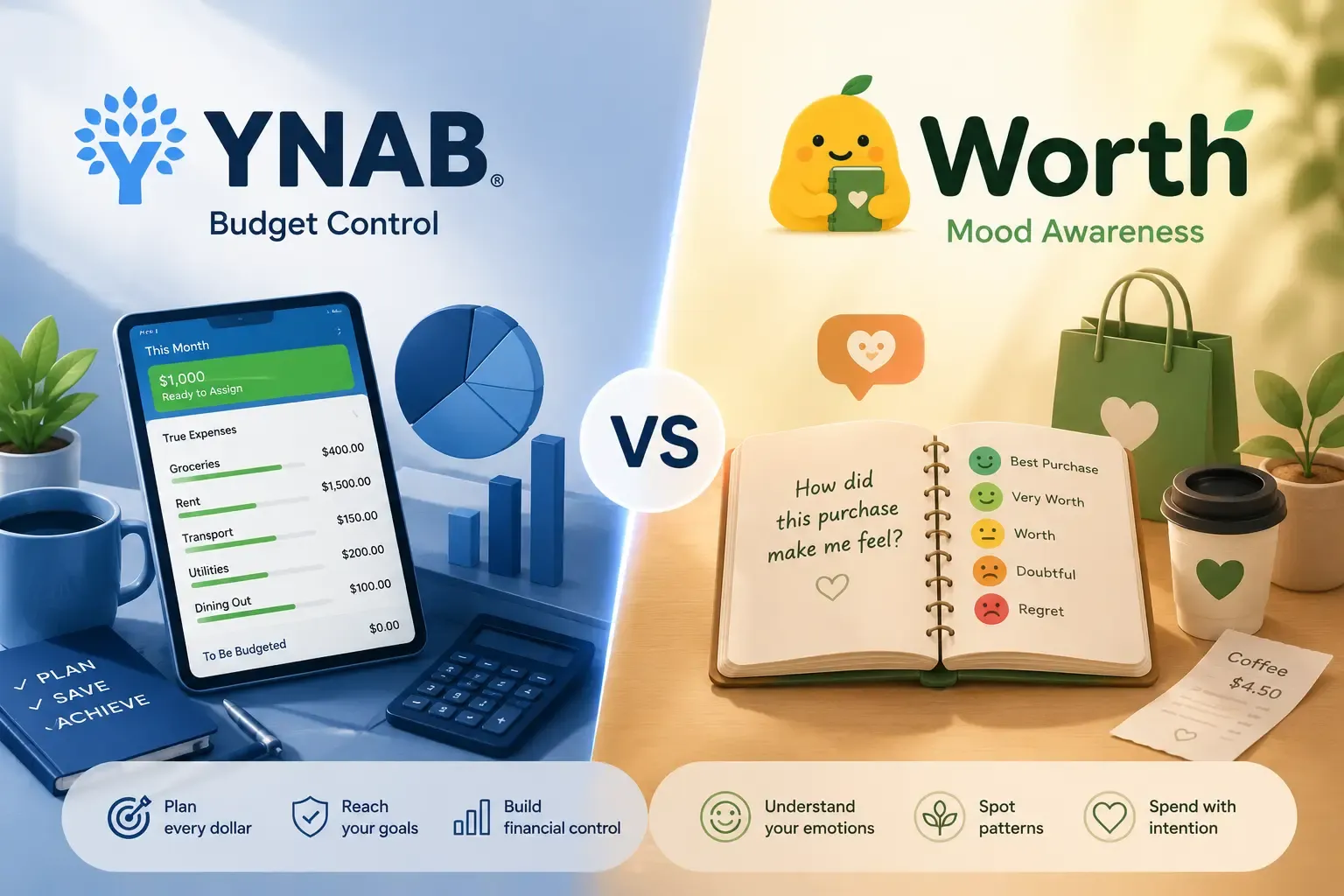
YNAB vs Worth: Budget Control vs Mood Awareness Compared (2026)
Wed Jul 15 2026
TL;DR: YNAB wins for strict budget control, debt payoff planning, and zero-based budgeting. Worth wins for emotional insight, simplicity, and building long-term spending awareness. Choose YNAB if you need to enforce a budget. Choose Worth if you want to understand why you spend. Many people use both: YNAB for planning, Worth for reflection.
YNAB (You Need A Budget) is the dominant force in zero-based budgeting, with over 4 million users, a 4.8-star App Store rating, and a loyal community that swears by its “give every dollar a job” methodology. Worth is a newer approach: a free mood-based expense journal that tracks not just how much you spend but how each purchase makes you feel.
The Mint shutdown in 2024 sent millions of budgeters searching for a replacement. Most landed on YNAB or Monarch Money. But a growing number are discovering that the problem is not the budget. It is the awareness. And that is where Worth enters the picture.
Quick Comparison Table
| Category | YNAB | Worth |
|---|---|---|
| Best For | Strict budget control and debt payoff | Understanding spending emotions |
| Core Method | Zero-based budgeting (give every dollar a job) | Mood-based reflection (rate every purchase) |
| Pricing | $109/year or $14.99/month | Free |
| Bank Sync | Yes (automatic transaction import) | No (manual entry) |
| Emotional Tracking | No | Yes - 5 mood ratings per purchase |
| Net Worth Tracking | Yes | No |
| Debt Payoff Planner | Yes (loan simulator + goal tracking) | No |
| Learning Curve | Moderate (requires setup and ongoing attention) | Minimal (start tracking in 10 seconds) |
| Behavior Change Method | External discipline (enforced categories) | Intrinsic awareness (pattern recognition) |
| Platforms | iOS, Android, Web, Apple Watch | Android (Google Play) |
| Our Verdict | Best for financial control | Best for emotional awareness |
Which Has Better Budgeting?
YNAB wins on budgeting because zero-based budgeting is the most effective system for planned spending control. YNAB requires you to assign every dollar a job before you spend it. This forces intentionality at the planning stage. You decide in advance what your money will do, and the app tracks your progress against those decisions.
YNAB’s four rules methodology is battle-tested. Users report paying off an average of $6,000 in debt in their first year. The app supports multiple budget categories, rollover for under-spent categories, and detailed reporting on where your money went. For pure budgeting, it is the gold standard.
Worth does not do budgeting. It does not have categories, spending limits, or debt payoff calculators. It is not designed to replace a budget. It is designed to complement one. If you need a budget, YNAB is the clear choice.
Verdict: YNAB wins on budgeting. Worth does not compete here.
Which Provides More Emotional Insight?
Worth wins on emotional insight because it is the only tool in this comparison that tracks how you feel about your purchases. This is not a feature YNAB offers, and it is not a feature YNAB is designed to offer. YNAB tracks dollars. Worth tracks feelings.
When you log a purchase in Worth, you rate it on a five-point scale: Best Purchase, Very Worth, Worth, Doubtful, Regret. Over time, patterns emerge. You might discover that 80% of your regret purchases happen after 10 PM. Or that takeout orders consistently land in the “Doubtful” category while grocery runs land in “Very Worth.”
This data is invisible to traditional budgeting tools. YNAB can tell you how much you spent on dining out. It cannot tell you whether those meals brought you joy or regret. Worth fills that gap.
Verdict: Worth wins on emotional insight. YNAB does not compete here.
Which Is Easier to Stick With?
Worth wins on ease of sticking with it because it requires less ongoing effort and does not trigger the guilt cycle that causes people to abandon budgets. A 2025 study in the Journal of Consumer Behaviour found that restrictive budgeting approaches fail for 80% of users within six months. The reason is not that budgets are bad. It is that they rely on willpower, and willpower is finite.
Worth requires 10 seconds per transaction. You log what you spent and how you feel. There is no category to choose, no budget to balance, no guilt when you overspend. The app is designed for reflection, not restriction. This lower friction means users are more likely to stick with it long-term.
YNAB requires upfront setup, ongoing category management, and regular reconciliation. For people who are motivated by structure, this is a feature. But for people who have tried and failed at budgeting before, this is a barrier.
Verdict: Worth wins on stickiness for people who struggle with traditional budgets.
Which Changes Long-Term Behavior?
This category is a tie because YNAB and Worth change behavior through fundamentally different mechanisms. YNAB uses external discipline: the budget structure forces you to make decisions in advance. Worth uses intrinsic awareness: seeing your emotional patterns changes how you think about spending.
A 2026 Intuit survey found that 49% of consumers are committing to mindful spending. These people do not need more budget discipline. They already know what they should do. They need to understand why they do what they do. Worth addresses that need.
YNAB users often report that after a year of zero-based budgeting, they internalize the habit and no longer need the app. The methodology becomes automatic. Worth users report a similar effect: after a few weeks of logging moods, they start pausing before purchases naturally, without needing to log every transaction.
The best outcome is using both. YNAB for the structure. Worth for the awareness.
Verdict: Tie. YNAB for external discipline. Worth for internal awareness.
Pricing Comparison
YNAB costs $109 per year or $14.99 per month, with a 34-day free trial. College students get a free year. Worth is completely free with no subscriptions, no trials, and no paid tiers. There is no cost barrier to trying Worth.
For the price, YNAB delivers a complete budgeting system with bank sync, reporting, and community support. The cost is justified for people who need the structure and will use the features. For people who simply want to understand their spending emotions, paying $109 for a budgeting tool they will not use is hard to justify.
Worth is free because it is built on a different model. It replaces nothing. It adds a layer of awareness that no budgeting tool provides. The cost of entry is zero.
Value verdict: YNAB is worth the price if you need budgeting. Worth is free and delivers unique value that no paid tool offers.
Who Should Choose What
People who need strict budget control. Choose YNAB. If you have debt to pay off, irregular income to manage, or you thrive on structure and categories, YNAB is the proven choice.
People who want to understand their spending emotions. Choose Worth. If you already know how to budget but still find yourself spending in ways you do not understand, Worth will show you the patterns that budgets miss.
People who want both control and awareness. Use YNAB for planning and Worth for reflection. They complement each other. YNAB tells you where your money went. Worth tells you how you felt about it.
People who have never budgeted before. Start with Worth. The low friction and immediate insight will build spending awareness without the overwhelm of a full budgeting system. Add YNAB later if you need more structure.
Frequently Asked Questions
Is YNAB better than Worth?
They serve different purposes. YNAB is better for budgeting. Worth is better for emotional awareness. The best answer depends on what you need. If you need to control where every dollar goes, choose YNAB. If you need to understand why you spend the way you do, choose Worth.
Can I use YNAB and Worth together?
Yes. Many people use both. YNAB handles the planning side: setting budgets, tracking categories, managing debt. Worth handles the reflection side: logging how each purchase makes you feel. The two apps address different parts of the financial wellness equation.
Is Worth a replacement for YNAB?
No. Worth is not a budgeting tool. It does not track categories, set spending limits, or sync with bank accounts. It is a mood-based expense journal designed to build spending awareness. If you need a budget, you need a separate tool. Worth fills the gap that budgeting tools leave open.
Is Worth still worth using in 2026?
Yes. 49% of consumers are committing to mindful spending in 2026 (Intuit, 2026). The shift toward intentional spending is accelerating. Worth is designed specifically for this shift, and it is free. There is no reason not to try it.
Which has better reviews?
YNAB has a 4.8 rating on the App Store and 4.5 on Google Play with thousands of reviews. Worth is newer with fewer reviews but strong engagement from users who value the emotional tracking approach. Review counts are not directly comparable given the difference in market presence.
Verdict
| Category | Winner |
|---|---|
| Budgeting | YNAB |
| Emotional Insight | Worth |
| Ease of Sticking With It | Worth |
| Long-Term Behavior Change | Tie |
| Pricing | Worth |
| Overall | Choose based on your need. Use both for best results. |
YNAB and Worth are not competitors. They are complementary tools for different parts of the same problem. YNAB gives you control over your money. Worth gives you understanding of your spending. Download Worth on Google Play and see what your spending has been trying to tell you.
Sources
- YNAB Pricing and Features. Retrieved 2026-07-14. https://www.ynab.com/pricing
- Intuit Financial Wellness Survey 2026. Retrieved 2026-07-14. https://www.intuit.com/blog/innovative-thinking/2026-financial-forecast-mindful-stress/
- NerdWallet: Best Budget Apps 2026. Retrieved 2026-07-14. https://www.nerdwallet.com/article/finance/best-budget-apps
- Journal of Consumer Behaviour (2025). Restrictive Budgeting Failure Rates. Retrieved 2026-07-14.